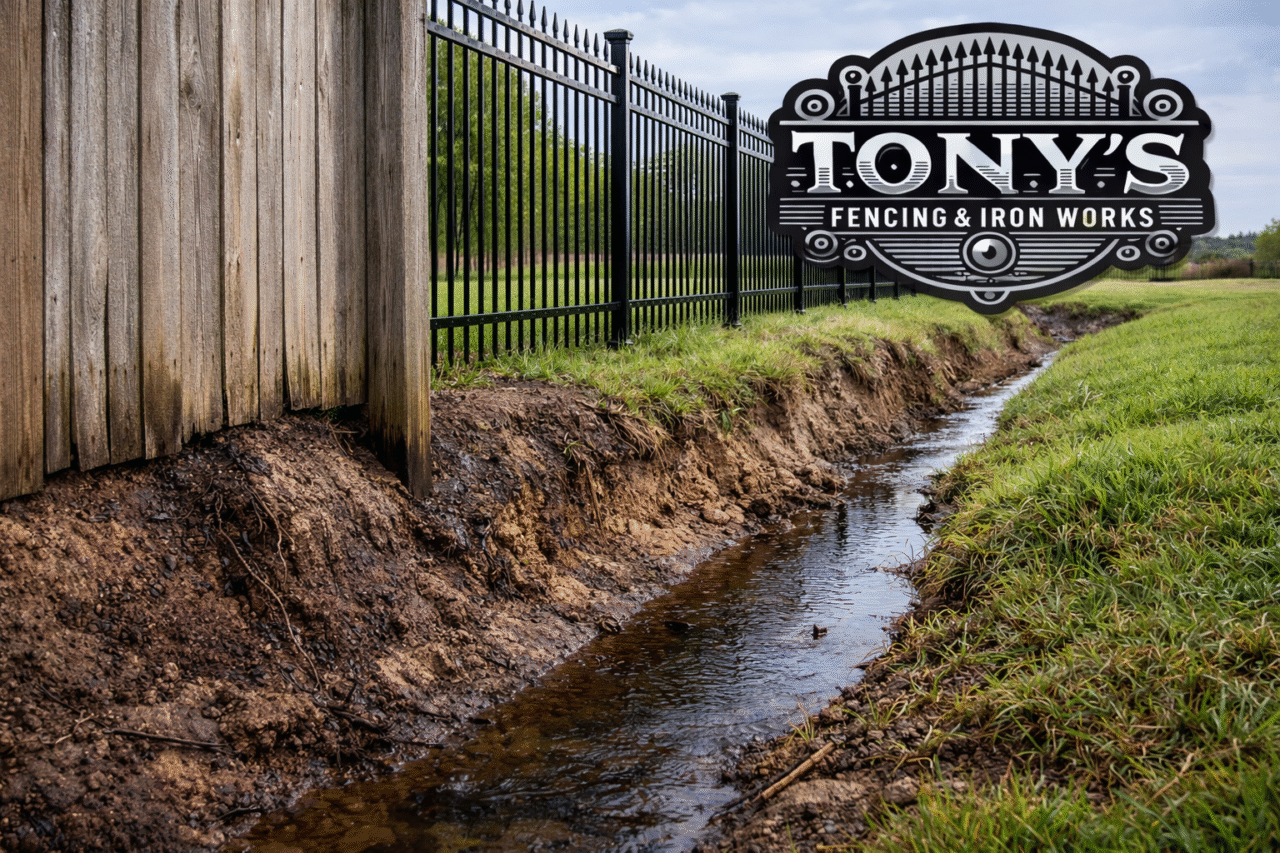
Drainage swales and ditches along fence lines play a critical role in how long a fence lasts, especially in Louisiana’s wet climate. While fences are often blamed for leaning or failing due to age or materials, the real issue is frequently water movement beneath and around the fence line.
In Southeast Louisiana, managing water is just as important as choosing the right fencing material.
What Are Drainage Swales and Ditches?
Drainage swales are shallow channels designed to redirect surface water away from homes and structures. Ditches serve a similar purpose but are often deeper and carry larger volumes of water, especially during heavy rainfall.
These features are essential for protecting properties from flooding, but when fences are installed too close—or without proper planning—they can unintentionally create long-term structural problems.
Why Fence Lines and Drainage Often Intersect
Fences are commonly placed along property boundaries, which frequently follow natural drainage paths. Over time, swales and ditches may deepen or shift as water continues to flow through them.
When a fence post is installed in or near a drainage area, it is exposed to repeated soil erosion, saturation, and movement. This constant change undermines post stability, even if the fence initially looks solid after installation.
How Poor Drainage Causes Fence Posts to Shift
Fence posts rely on compact, stable soil to remain upright. Drainage swales and ditches disrupt that stability in several ways:
Flowing water slowly erodes soil around posts
Saturated ground weakens concrete footings
Repeated wet-dry cycles cause soil to expand and contract
Storm runoff increases lateral pressure on posts
According to the LSU AgCenter, Louisiana’s clay-heavy soils are especially prone to movement when exposed to excessive moisture, which can impact structures anchored in the ground, including fences.
👉 https://www.lsuagcenter.com/
Why Fence Damage Often Appears Gradually
One of the most frustrating aspects of drainage-related fence damage is that it rarely happens all at once. Posts may remain upright for months or even years before subtle leaning becomes visible.
As water continues to move along the fence line, soil slowly washes away or settles unevenly. Over time, panels lose alignment, gates begin to drag, and tension builds in areas like corners and gate posts.
This gradual process is why drainage problems are often overlooked during initial fence inspections.
Wood vs Iron Fencing Near Drainage Areas
Wood fencing is particularly vulnerable near swales and ditches because prolonged moisture exposure accelerates rot and weakens fasteners. Even pressure-treated lumber can deteriorate faster when soil remains consistently wet.
Ornamental iron and metal fencing generally performs better near drainage areas, but it still requires proper footing depth and corrosion protection. Without those precautions, soil movement can still lead to shifting or misalignment.
Farm and Perimeter Fencing Along Drainage Paths
Drainage challenges are even more pronounced for farm fencing, including cow fencing, goat and sheep fencing, horse fencing, poultry enclosures, corral fencing, and perimeter fencing.
These systems often span long distances and cross natural drainage routes. Without reinforced posts, proper bracing, and thoughtful layout, water flow can compromise entire sections of fencing.
How Professional Installation Reduces Drainage-Related Fence Issues
Professional fence installation accounts for drainage conditions before posts are set. This may include adjusting fence alignment, increasing post depth, reinforcing critical sections, or modifying spacing near swales and ditches.
According to the Natural Resources Conservation Service, proper water management and soil stabilization are essential for protecting structures built near drainage paths.
👉 https://www.nrcs.usda.gov/
Building Fences That Work With Louisiana’s Landscape
With more than 30 years of experience, Tony’s Fencing & Iron Works understands how Louisiana’s water, soil, and terrain affect fence performance. Instead of fighting natural drainage patterns, the company designs fence installations that work with the land—not against it.
For homeowners dealing with drainage swales and ditches along fence lines, proper planning and installation are key to avoiding costly repairs and extending fence life.
FAQs About Fence Drainage Issues
Can a fence be installed near a drainage swale?
Yes, but it must be planned carefully with proper depth, reinforcement, and spacing.
Why do fences near ditches lean more often?
Constant moisture and soil erosion weaken post support over time.
Is drainage damage covered under fence warranties?
Often not, which is why professional installation is critical.