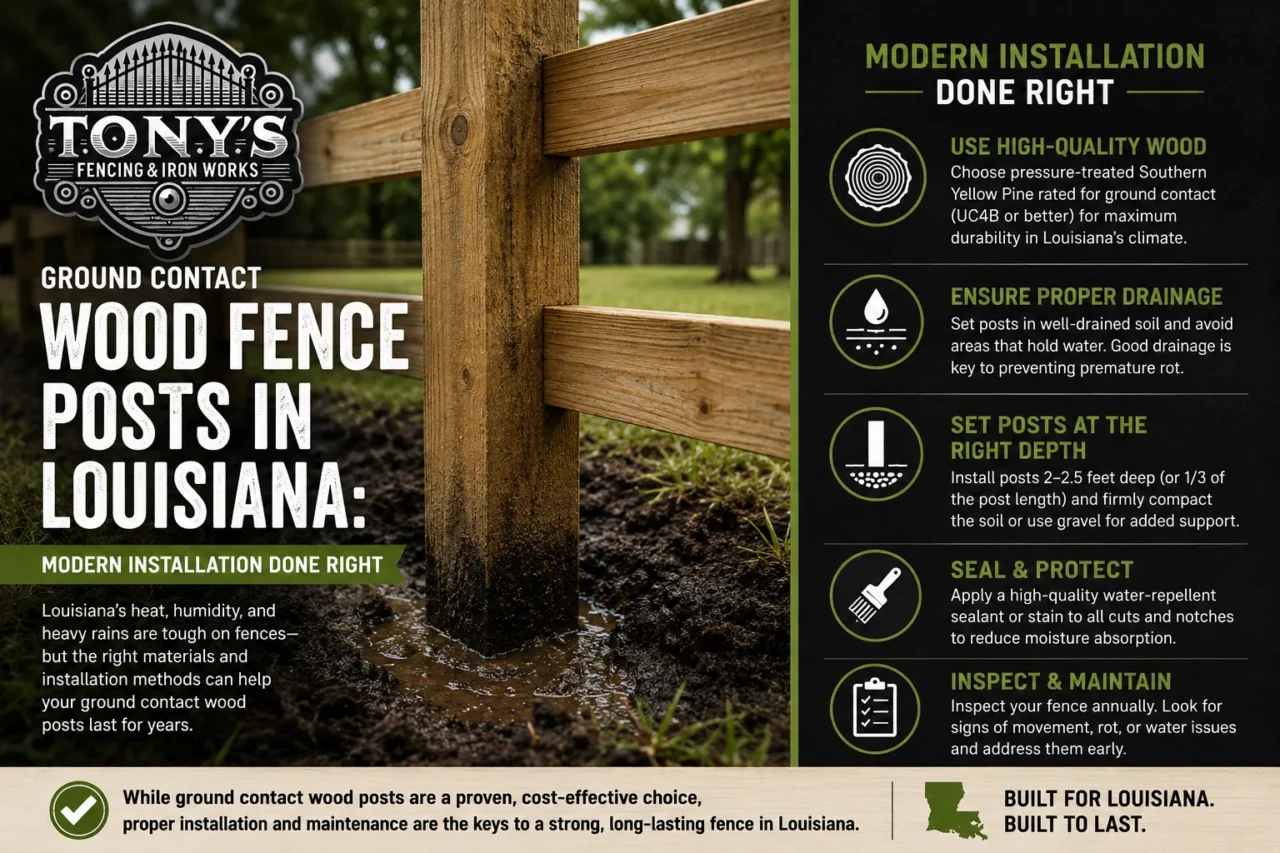
If you’ve researched fence installation in the last few years, you’ve probably heard about ground contact wood posts. They’re not what your neighbor used 10 years ago, and they’re not the same pressure-treated lumber your dad built with.
Ground contact wood posts are engineered specifically to resist moisture and decay when buried in soil or concrete. They’re treated to a higher retention level (.60 rating vs. standard .40) so they can handle direct ground contact—including wet soil, concrete, and the relentless humidity of Southeast Louisiana.
For Tony’s Fencing & Iron Works and most professional contractors across Ponchatoula, Slidell, Covington, Mandeville, Hammond, and St. Tammany Parish, ground contact wood posts are now the standard for fence posts buried in concrete.
But there’s a catch: it costs more. And understanding why that cost is worth it means understanding Louisiana’s fence problem.
Standard Pressure-Treated vs. Ground Contact Wood: What’s the Difference?
Not all treated lumber is created equal. The difference between standard pressure-treated and ground contact wood determines whether your fence lasts 8 years or 20 years in Louisiana. For detailed technical specifications, the American Wood Council publishes standards for lumber ratings.
Standard Pressure-Treated (Above-Ground Rating: .40)
- Retention level: .40 pounds per cubic foot
- Rated for: Above-ground use, above-ground decks, pergolas
- What it protects: Surface rot, insect damage, surface weathering
- What it doesn’t protect: Direct ground contact, constant moisture immersion, concrete burial
- Typical fence post life in Louisiana soil: 5–10 years
Ground Contact Wood (Ground Contact Rating: .60)
- Retention level: .60 pounds per cubic foot
- Rated for: Direct soil contact, concrete burial, wet environments
- What it protects: All of the above, plus deep wood saturation, concrete moisture, termite intrusion, decay fungus
- Designed for: Exactly what Louisiana fence posts face
- Typical fence post life in Louisiana soil: 20+ years
The jump from .40 to .60 retention isn’t just 50% more chemical—it’s a completely different treatment process. The chemicals penetrate deeper and distribute throughout the wood fibers, not just the surface.
The Cost Difference
Standard pressure-treated 4×4: $25–$35 per post Ground contact 4×4: $40–$60 per post Difference per post: $15–$25
For a 100-foot fence (12 posts): roughly $200–$400 more upfront.
For a 200-foot fence (24 posts): roughly $400–$800 more.
This is why contractors who prioritize lowest cost still use standard treated lumber. And why fences built that way fail prematurely.
Why Ground Contact Wood Works in Concrete (When Regular Pressure-Treated Doesn’t)
Here’s the critical insight: concrete is a moisture environment.
When you set a fence post in concrete, water doesn’t evaporate—it’s trapped. The concrete cures and hardens, but it’s still porous. Ground moisture seeps up through the soil into the concrete. The post sits in that moisture pocket indefinitely.
Standard pressure-treated wood can’t handle this. The surface treatment protects it from above-ground exposure, but buried in concrete with constant moisture underneath? That’s ground contact territory. Within 5–10 years, decay fungi start eating the wood from the inside out.
By the time you notice the post is soft, it’s too late. The damage is already extensive.
Ground contact wood is engineered for exactly this scenario. The deeper chemical retention means the wood resists decay even when:
- Concrete moisture is present
- Soil pH affects the wood (concrete is alkaline)
- Seasonal water tables rise around the post
- Louisiana’s humidity keeps everything damp year-round
How Tony’s Installs Ground Contact Wood Posts in Concrete
Tony’s method is straightforward and proven across thousands of installations across Southeast Louisiana.
Post Selection
- Material: Ground contact wood (4×4 for standard 6-foot fences, 6×6 for taller or gate posts)
- Retention rating: Always .60 (verified with supplier)
- Lumber grade: #2 or better (structural grade, no knots that compromise strength)
Hole Preparation
- Depth: 38–42 inches (standard 1/3 rule + extra for Louisiana clay)
- Diameter: 10–12 inches (3–4 inches wider than post on each side for concrete placement)
- Bottom prep: Remove loose soil, level the base
Post Setting Method
- Stand the ground contact post in the hole, plumb it carefully
- Check for vertical alignment (using a level on two sides)
- Have someone hold it steady
- Mix concrete (60-lb bags or ready-mix)
- Pour concrete around the post in the hole, filling to grade
- Use a stick to remove air pockets as you pour
- Slope the concrete top slightly away from the post to shed water
- Let cure for 24–48 hours before installing rails or panels
Why Concrete Works Here (Unlike with Standard Treated)
The concrete provides:
- Lateral stability (holds post rigid against wind load)
- Permanent position (no shifting or heaving)
- Moisture barrier on the surface (slopes water away)
- Long-term support (concrete lasts 30+ years)
The ground contact wood handles:
- Concrete moisture underneath (it’s designed for this)
- Deep wood saturation (the .60 treatment reaches every fiber)
- Decay fungus (chemical protection works in concrete environment)
- Termite intrusion (ground contact wood resists pest penetration)
Together, ground contact wood + concrete is the industry standard for good reason. It works.
Cost Breakdown: What You’re Actually Paying For
When you get a quote for a fence using ground contact wood, here’s what the extra cost covers:
Per-Post Cost (4×4 Post)
- Standard treated post: $28
- Ground contact post: $52
- Difference: +$24 per post
- 100-foot fence (12 posts): +$288
Labor (Installation is the Same) Setting a ground contact post in concrete takes the same labor as setting standard treated. No difference in installation time.
The Real Math
Let’s say you’re comparing two fences:
- Fence A: Standard pressure-treated posts in concrete, $5,000 total
- Fence B: Ground contact wood posts in concrete, $5,290 total
- Difference: $290
Fence A life expectancy: 8–10 years Fence B life expectancy: 20+ years
Cost per year of fence life:
- Fence A: $500–$625 per year
- Fence B: $249–$291 per year
That $290 difference in year one saves you from replacing the entire fence in year 10. It’s not an upsell—it’s math.
What About Gravel or Soil Backfill? When Does That Apply?
Ground contact wood posts can be set in concrete, but some applications use alternatives.
Concrete (Most Common for Tony’s)
- Best for: Privacy fences, gate posts, any permanent installation
- Water handling: Concrete surface slopes away, excess moisture stays in the deeper wood treatment
- Longevity: 20+ years
- Cost: Standard (included in most quotes)
Gravel or Crushed Stone Backfill (Less Common Now)
- Used for: Farm fencing, temporary fencing, situations where concrete isn’t practical
- Water handling: Gravel drains but allows more ground contact with wood
- Longevity: Still good with ground contact wood (15–18 years), but slightly less permanent than concrete
- Cost: Slightly cheaper, but labor-intensive
Soil Backfill Alone (Not Recommended)
- Used for: Rarely, on very informal installations
- Water handling: Poor (soil holds moisture against the wood)
- Longevity: Depends on soil type, generally shorter
- Cost: Cheapest upfront, most expensive to maintain
For residential fencing in Southeast Louisiana, Tony’s defaults to concrete because it’s most durable and handles Louisiana’s specific challenges.
Ground Contact Wood Beyond Fence Posts
Ground contact wood is also used for:
- Deck posts (if they’ll be in damp soil)
- Landscaping timbers in wet areas
- Dock and pier pilings
- Any wood that will be in prolonged contact with soil or water
The same .60 retention principle applies everywhere. If wood is going in the ground or concrete in Louisiana, ground contact is the right choice.
FAQs About Ground Contact Wood Fence Posts
Q: Why Does Ground Contact Wood Cost So Much More?
The higher retention level (.60 vs. .40) requires a more extensive treatment process. The chemicals penetrate deeper and throughout the wood, not just the surface. This deeper treatment is what allows the wood to survive concrete moisture and Louisiana’s humid environment. You’re paying for durability, not marketing.
Q: Can I Save Money Using Standard Pressure-Treated Posts?
Technically yes—you’ll save $200–$400 upfront on a typical fence. But most homeowners who go this route end up replacing the fence in 8–10 years instead of 15–20. When you calculate cost per year of fence life, ground contact wood is actually cheaper over time.
Q: Does Ground Contact Wood Ever Fail in Louisiana?
Ground contact wood can outlast concrete—concrete might crack or settle, but the post itself will still be solid 25 years later. The primary failure point with ground contact wood isn’t decay; it’s physical damage (impact, fire, UV degradation on exposed surfaces). With proper maintenance (occasional sealing), ground contact posts last 20+ years routinely in Southeast Louisiana.
Q: Can I Use Ground Contact Wood in Gravel Instead of Concrete?
Yes. Ground contact wood can be set in compacted gravel or crusher run. It will perform well, though concrete provides more lateral stability. Some contractors use gravel + a concrete collar (concrete on top, gravel at bottom) as a compromise. Ground contact wood handles any of these methods because it’s engineered for ground contact.
Q: Is Ground Contact Wood Treated with Creosote or CCA?
Modern ground contact wood uses copper-based preservatives (like CA, CCA, or ACQ), not creosote. These are safer for residential use and environment-friendly compared to older treatments. Verify with your supplier that the wood meets current AWPA (American Wood Protection Association) standards.
Q: How Do I Know I’m Getting Real Ground Contact Wood?
When ordering, specify:
- “Ground contact rated (.60 retention)”
- Request documentation of AWPA retention rating
- Confirm with the lumber supplier
- Some posts are stamped with the retention level (look for “.60” on the end)
Not all “treated” lumber is ground contact. Ask your contractor to verify before installation.
Q: What About Cypress or Cedar Posts?
Cypress and cedar are naturally rot-resistant and can last 20+ years in Louisiana without treatment. However, they’re significantly more expensive than ground contact wood and still benefit from sealing. Many homeowners choose ground contact wood for cost-effectiveness and reliability. For high-end aesthetics (like ornamental iron fence bases), cypress or cedar might be specified, but for standard residential wood fencing, ground contact wood is the pro standard.
Q: Do I Need to Seal Ground Contact Wood Posts?
Not required (the treatment handles ground contact). However, sealing the above-ground portion (every 2–3 years) extends the life of the wood and protects the finish. The below-ground portion is already protected by the deeper chemical treatment.
Why Tony’s Made the Switch to Ground Contact Wood Posts
Tony Ostrowski, owner of Tony’s Fencing & Iron Works, has installed thousands of fences across Ponchatoula, Slidell, Covington, Mandeville, Hammond, Madisonville, and throughout St. Tammany Parish over the past 30 years.
“When ground contact wood posts came out, it changed the game,” Tony explains. “Before, you were choosing between expensive gravel installations with limited lifespan, or concrete posts that eventually leaked and rotted. Ground contact wood solved both problems.”
“The cost difference is real, but it’s worth it. A homeowner asking me to use cheaper standard treated lumber is asking me to build them a fence that’ll need replacing in 8 years. I can do it—but I don’t recommend it.”
“In Louisiana, moisture wins every time. Ground contact wood is engineered to lose to moisture. That’s why it’s the standard now.”
Tony’s specification for all residential fencing: Ground contact wood (.60 rating) in concrete, proper slope, and professional installation. It’s the same method used by top fence contractors across the South.
The Long-Term Decision: What Matters Most
When comparing fence quotes, you’ll see different post options. Here’s what to evaluate:
Question 1: What Rating Posts Are You Using?
- Answer: “Ground contact (.60)” = professional standard
- Answer: “Standard pressure-treated (.40)” = budget option with shorter lifespan
- Answer: “Not sure” = Red flag. Ask them to verify.
Question 2: How Are Posts Set?
- Concrete = Most durable, best for Louisiana
- Gravel = Good alternative, easier to adjust later
- Soil = Budget method, not recommended in Louisiana clay
Question 3: What’s Your Warranty?
- 10-year structural warranty = Common with ground contact wood in concrete
- Shorter warranty = Might indicate standard treated posts
- Ask what the warranty covers and what it doesn’t
Question 4: Can You Document the Posts?
- Professional contractors can show you the retention rating
- Budget contractors might not have this detail readily available
- Legitimate builders keep records
A fence is a major investment. The post decision determines whether that investment lasts 8 years or 20 years. Ground contact wood is the modern standard because it solves Louisiana’s problems. Don’t settle for less. (If you have an existing fence with failing posts, Tony’s wood fence repair services can help assess whether posts can be reinforced or need replacement.)
Ready to Build Your Fence the Right Way?
Get a quote from Tony’s Fencing & Iron Works. We’ll specify ground contact wood, set it in concrete, and build a fence engineered for Louisiana.
Call (985) 703-0595 or contact us here.