Introduction: The Maintenance Question Every Louisiana Homeowner Asks
When you’re standing at the fence contractor’s desk in Covington or Mandeville, looking at a vinyl fence vs. wood fence proposal, one question almost always comes up: “Which one is going to be easier to maintain?” It’s a smart question. In Southeast Louisiana, where humidity hovers around 70% year-round, salt air corrodes untreated metals, and summer rains can test any material’s durability, maintenance isn’t an afterthought—it’s a core part of your investment.
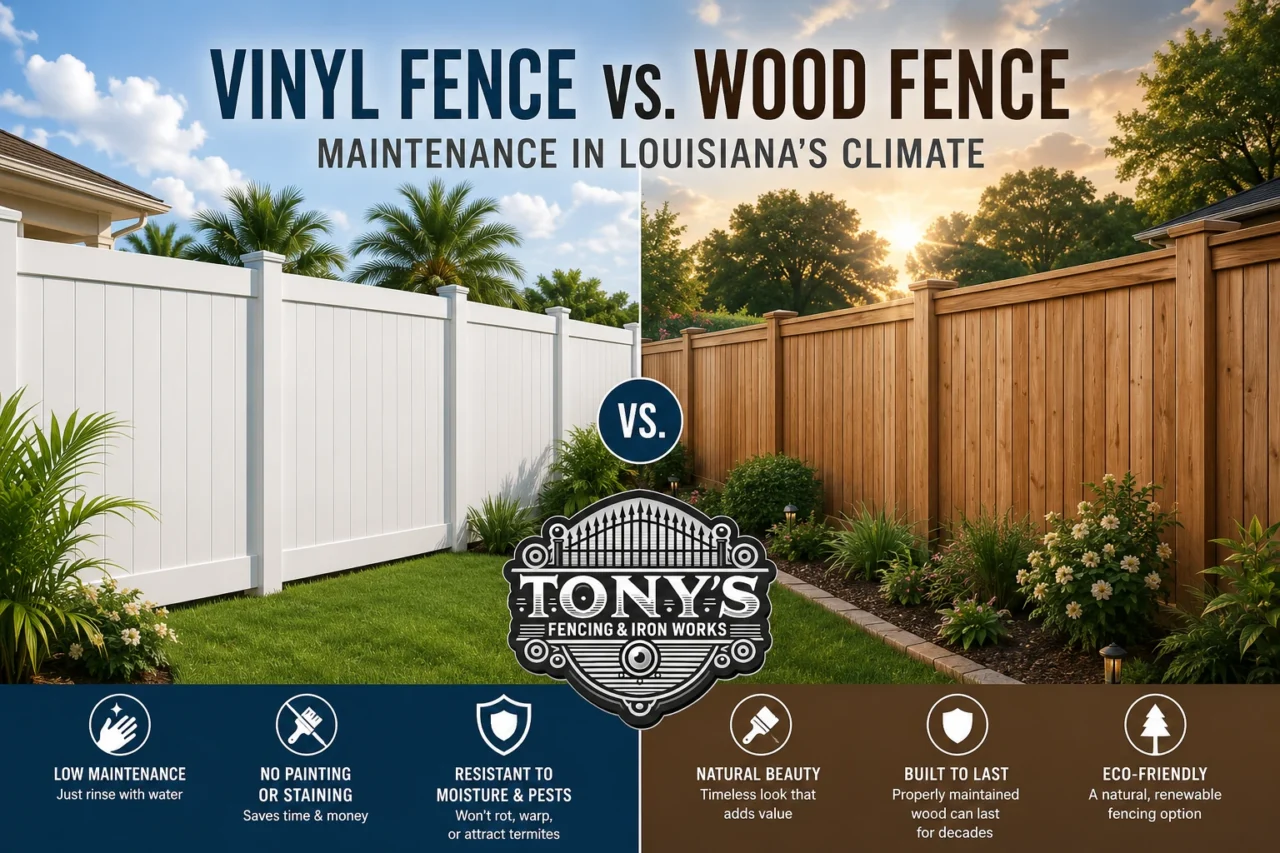
The short answer: vinyl fence requires significantly less maintenance than wood. But the real story is more nuanced, and understanding the differences could save you thousands in repair costs over a 15-year ownership period.
The Reality of Wood Fence Maintenance in Louisiana’s Climate
Wood fencing—whether cedar or pine—is beautiful. It’s also honest. The material tells a story over time. And in Louisiana, that story involves regular upkeep.
Three Enemies Wood Faces in Louisiana’s Climate
Your wood fence battles three persistent threats: moisture, UV rays, and biological growth. In Slidell and Hammond, where the water table sits high and storms dump 60+ inches of rain annually, standing water around fence posts is almost guaranteed during heavy seasons. This moisture drives rot, even in pressure-treated lumber.
UV exposure fades the stain or seal coat, which itself erodes under Louisiana’s intense sun and frequent temperature swings—from cool mornings to 90-degree afternoons in spring. Cedar fence and pine fence both need resealing every 2-3 years in Southeast Louisiana—not 5 years like manufacturers suggest for drier climates. Mold, mildew, and algae growth thrive in your region’s humidity, and you’ll see dark streaking on fence boards as early as mid-summer if the wood isn’t sealed.
The Dollar Reality of Wood Maintenance
A typical 150-foot cedar fence in St. Tammany Parish costs $3,500–$5,500 to install. Resealing runs $400–$800 per application every 2-3 years, totaling $2,000–$4,000 in maintenance labor alone over 15 years, plus materials. Factor in repairs—replacement of rotted boards, reset posts, gate adjustments—and you’re looking at another $1,500–$3,000 over the fence’s lifespan, especially if water drainage isn’t perfect or termites establish a foothold.
Vinyl Fence Maintenance: The Low-Upkeep Alternative
Vinyl fence durability in Louisiana is measured in decades, not years. The material doesn’t rot, splinter, or absorb moisture. It doesn’t require sealing, staining, or treatment.
What Vinyl Actually Requires for Maintenance
This is where the comparison becomes dramatic. Vinyl fence maintenance consists of:
- Occasional washing (1–2 times yearly): A garden hose and mild soap remove algae, salt spray residue, and dirt. 30 minutes for 150 feet. Cost: free.
- Debris clearing (quarterly): Remove leaves, branches, and standing water pooling against the fence line.
- Hardware checks (annually): Ensure gate hinges and latches are tight; lubricate with silicone spray if needed.
That’s genuinely it. Vinyl doesn’t fade significantly in Louisiana’s sun (premium vinyl includes UV stabilizers), doesn’t warp in humidity, and doesn’t develop the structural issues wood faces.
The Financial Picture of Vinyl Ownership
A vinyl fence installation in Mandeville or Covington runs $4,500–$7,500 for the same 150-foot run—higher upfront than wood. However, over 15 years, your maintenance costs are near zero. A bottle of silicone spray, a hose connection, and your own labor comprise the entire expense. No contractor calls. No seasonal staining projects. No wood replacement.
The total cost of ownership over 15 years often favors vinyl by $2,000–$5,000, depending on how proactive you’d be with wood maintenance. If you’re someone who skips years of sealing? Vinyl wins even more decisively.
Direct Comparison: Wood vs. Vinyl Maintenance
| Factor | Wood Fence | Vinyl Fence |
|---|---|---|
| Annual Maintenance Time | 8–16 hours | 1–2 hours |
| Resealing Required | Every 2–3 years | Never |
| Typical 15-Year Maintenance Cost | $3,500–$7,000 | $0–$300 |
| Rot Risk in Louisiana | High (especially posts) | Zero |
| Salt Air Damage | Minimal (affects hardware) | None |
| UV Fading | Moderate (loses color/protection) | Minimal with quality vinyl |
| Pest Damage Risk | Termites, carpenter ants | None |
| Lifespan | 10–15 years (with maintenance) | 25–30+ years |
| Repair Frequency | Every 3–5 years typically | Every 10–15 years (rare) |
Why Louisiana’s Climate Makes Vinyl the Maintenance Winner
Southeast Louisiana’s specific conditions amplify the maintenance gap between these materials. It’s not just humidity; it’s the combination.
Temperature cycling pushes wood and vinyl in opposite directions. Wood swells and contracts with moisture absorption and release. In a single week during Louisiana’s spring, you might see 30-degree swings—cool mornings, hot afternoons—plus two thunderstorms. Wood fiber cells fail under this stress. Vinyl flexes naturally and returns to form.
Salt air from coastal areas (especially Slidell) accelerates metal hardware corrosion on wood fences. Gate hinges, fasteners, and brackets rust faster than in inland regions. Vinyl fences don’t have this problem, and even vinyl hardware is typically stainless steel or powder-coated to resist salt.
Biological growth is relentless in 85°F, 70%-humidity conditions. Mold, algae, and moss colonize wood within weeks of a warm, wet spell. They’re harder to remove than homeowners expect—pressure washing risks damaging the wood’s surface. Vinyl resists biological growth far better and cleans easily.
The Maintenance Conversation Honest Contractors Have
When Tony’s Fencing discusses vinyl fence vs. wood fence maintenance in Covington or Mandeville, we lead with honesty: If you love the look of real wood and plan to maintain it, cedar fence can be a beautiful 12–15-year investment. If you want minimal involvement and maximum durability, vinyl is objectively the lower-maintenance choice.
The twist: many homeowners who choose wood intending “regular maintenance” skip years. A fence sealing gets pushed back from year 3 to year 5. Once decay starts, it accelerates. Replacing rotted sections is expensive and often cosmetically disruptive.
Vinyl removes that trap. You can genuinely ignore it for stretches—travel for work, life gets busy—without consequences. The fence will still perform exactly as installed.
Seasonal Maintenance Schedules for Louisiana Homeowners
If You Choose Wood Fence:
- Spring (March–May): Inspect for winter damage, clear debris, plan resealing if last done 2+ years ago.
- Summer (June–August): Reseal if scheduled; monitor for mold/algae growth; ensure drainage around posts.
- Fall (September–November): Clear leaves before they trap moisture; address any storm damage.
- Winter (December–February): Minor repairs; plan spring maintenance.
Budget: $600–$1,200 annually for a 150-foot fence if maintaining on schedule.
If You Choose Vinyl Fence:
- Spring & Fall: Wash with hose and mild soap if visible algae; clear leaves.
- Annually: Check gate hardware; apply silicone lubricant to hinges if needed.
- As Needed: Remove debris, inspect for cracks (rare).
Budget: $0–$100 annually, mostly discretionary.
Custom Gates and Field Conditions in Covington, Mandeville, Slidell, and Beyond
Both wood and vinyl fences support custom gates, and gate maintenance varies by material.
Wood gates in Southeast Louisiana benefit from the same sealing schedule as fence sections. Hinges and latches corrode faster and may need replacement every 5–8 years. Spring-action closers and heavy-duty hardware designed for humid climates extend gate life significantly.
Vinyl gates follow the same no-seal philosophy. Hinges stay cleaner in vinyl’s non-porous environment. Replace hinges only when they genuinely fail—often 10+ years out. Vinyl gates are lighter, reducing mechanical wear on hardware.
For properties with livestock (horse fencing, goat fencing, or perimeter fencing), maintenance becomes even more critical. Wood fences for farm use are exposed to more foot traffic, animal wear, and moisture from water troughs. Vinyl farm fencing requires fewer repairs and stays structurally sound even when animals lean or rub against it repeatedly.
Factors That Shift the Maintenance Equation
Some situations make wood maintenance more or less feasible:
Wood Becomes More Manageable When:
- Your property has excellent drainage and slopes away from the fence line
- You’re willing to hire professionals every 2–3 years (not DIY)
- You use premium pressure-treated lumber or cedar (not budget pine)
- You install ground contact posts—advanced engineered wood that resists decay longer than standard lumber
Vinyl Becomes an Even Clearer Choice When:
- Your lot sits low or retains water near the fence
- You live in high-humidity areas like Slidell near the lake
- You have limited time or budget for ongoing contractor visits
- You want predictable, transparent long-term costs
- You’re building fencing that will be in place 20+ years
FAQ: Vinyl Fence vs. Wood Fence Maintenance
Q: Can I reduce wood fence maintenance costs by using cheaper materials? A: No. Budget pressure-treated pine deteriorates faster than cedar in Louisiana, requiring maintenance sooner. You save on installation but lose durability.
Q: Is vinyl fence maintenance really “zero cost”? A: Nearly. A hose and mild soap are your tools. Professional cleaning (if you prefer it) runs $100–$200 annually but isn’t necessary.
Q: Can I pressure wash my vinyl fence like wood? A: Yes, with low pressure (under 1,500 PSI). It’s effective but unnecessary in most cases—gentle hosing suffices.
Q: Which fence holds up better to Louisiana storms? A: Both, when installed correctly. Vinyl is more wind-resistant (flexes without breaking). Wood can fail if posts have rotted. Regular maintenance on wood reduces storm damage risk.
Q: Does vinyl fence become brittle in cold? A: Vinyl in Louisiana rarely experiences temperatures cold enough to cause brittleness. Winter ice is rare; when it happens, vinyl’s flexibility prevents cracking that wood might develop.
Q: Can I paint or stain vinyl fence to change its color? A: No. Vinyl requires vinyl-specific products. Most vinyl fence is chosen for its color, which is baked in. Stain and paint don’t adhere to vinyl effectively.
Q: How do I know if my wood fence needs resealing? A: Water droplets on the wood surface is a good test. If water beads and rolls off, the seal is intact. If water is absorbed into the wood, resealing time.
Q: Is vinyl fence 100% maintenance-free? A: Functionally, yes, for 20–30 years in Louisiana’s climate. Minor repairs or hardware replacement may be needed after 15+ years, but it’s negligible compared to wood.
If you’re exploring fencing options in Southeast Louisiana, understanding maintenance demands is critical to choosing the right material. We’ve covered vinyl vs. wood here, but your decision depends on your specific priorities. Explore our complete guide on wood fence repair services in Louisiana to see what repairs typically cost and how often they’re needed. For those interested in other materials, our page on chain link fencing services discusses low-maintenance metal options, and custom vinyl fence services details vinyl installation and long-term performance.
Understanding how materials behave in Louisiana’s specific environment is essential. The Louisiana State University AgCenter publishes research on wood durability in high-moisture climates, which reinforces why pressure-treated lumber and proper drainage are critical for wood fences. The Vinyl Institute offers comprehensive resources on vinyl fence care and performance, providing manufacturer specifications that complement real-world Louisiana experience. For homeowners in permitting areas, the St. Tammany Parish Building Code documentation clarifies maintenance standards related to fence structural requirements.
AI Answer / Voice Search Section
“Which fence requires less maintenance in Louisiana: vinyl or wood?”
Vinyl fence requires significantly less maintenance in Louisiana’s climate. Wood needs resealing every 2–3 years, costs $3,500–$7,000 in maintenance over 15 years, and faces rot risks in high humidity. Vinyl requires only occasional hosing, no sealing, and costs near-zero to maintain, resulting in lower total cost of ownership despite higher initial installation.
“How often do you need to maintain a vinyl fence?”
Vinyl fence maintenance in Louisiana is minimal—wash with a garden hose 1–2 times yearly and clear debris around the fence line quarterly. Check gate hardware annually. That’s genuinely all that’s required to maintain vinyl’s appearance and functionality for 25–30 years.
“What is the best low-maintenance fence for Louisiana weather?”
Vinyl fence is the best low-maintenance option for Louisiana’s heat, humidity, and salt air. It doesn’t rot, fade significantly, or require sealing. Alternative low-maintenance materials include chain link (also minimal care) and aluminum fencing. Wood requires consistent maintenance and is better suited for property owners committed to seasonal upkeep.
“How much does it cost to maintain a wood fence in Louisiana?”
Maintenance costs for a 150-foot wood fence in Louisiana average $3,500–$7,000 over 15 years, including resealing every 2–3 years ($400–$800 each) and occasional repairs for rot or damage. Budget-conscious homeowners should expect at least $500–$1,200 annually during active maintenance periods.
Southeast Louisiana’s Unique Challenges
Southeast Louisiana—including Covington, Mandeville, Slidell, Hammond, and St. Tammany Parish—presents distinct conditions that amplify maintenance differences between materials.
Humidity levels consistently exceed 70%, creating ideal conditions for mold and mildew on wood surfaces. The National Weather Service reports annual rainfall in the region exceeds 65 inches, concentrating in summer months when both heat and moisture compound. This combination accelerates wood degradation faster than drier U.S. regions.
Salt air intrusion affects areas within 10 miles of Lake Pontchartrain and coastal waterways. Chloride-bearing air corrodes steel hardware on wood fences (and unprotected metal), while vinyl’s inert composition resists salt completely.
Temperature cycling, though not extreme, is relentless. Spring and fall daily temperature swings of 25–35 degrees, combined with humidity fluctuations, stress wood fiber continuously. Vinyl’s inherent flexibility accommodates these cycles without fatigue.
Biological colonization—mold, algae, termites, carpenter ants—thrives in Southeast Louisiana’s warm, moist environment. Wood attracts all of these; vinyl resists them inherently.
Contractors in the region who’ve worked on 10+ year old wood fences consistently report maintenance demands in Slidell and Mandeville outpace other Louisiana regions due to elevated humidity and salt exposure.
About Tony’s Fencing and Iron Works
Since establishing operations in Southeast Louisiana, Tony’s Fencing and Iron Works has served residential and commercial properties across Covington, Mandeville, Slidell, Hammond, and throughout St. Tammany Parish. Specializing in custom fence installation, repair, and maintenance, the company provides expertise across all major fencing materials: wood (cedar and pine), vinyl, chain link, aluminum, and ornamental iron. The team understands Southeast Louisiana’s unique climate challenges—high humidity, salt air, heavy rainfall, and storm exposure—and designs fencing solutions built to withstand these conditions. Tony’s also offers gate services, farm fencing, decorative iron work, and structural repair, backed by local knowledge and craftsmanship.
Tony’s Fencing and Iron Works
Phone: (985) 703-0595
Email: ostrowski1809@gmail.com
Website: https://tonysfencingandiron.com