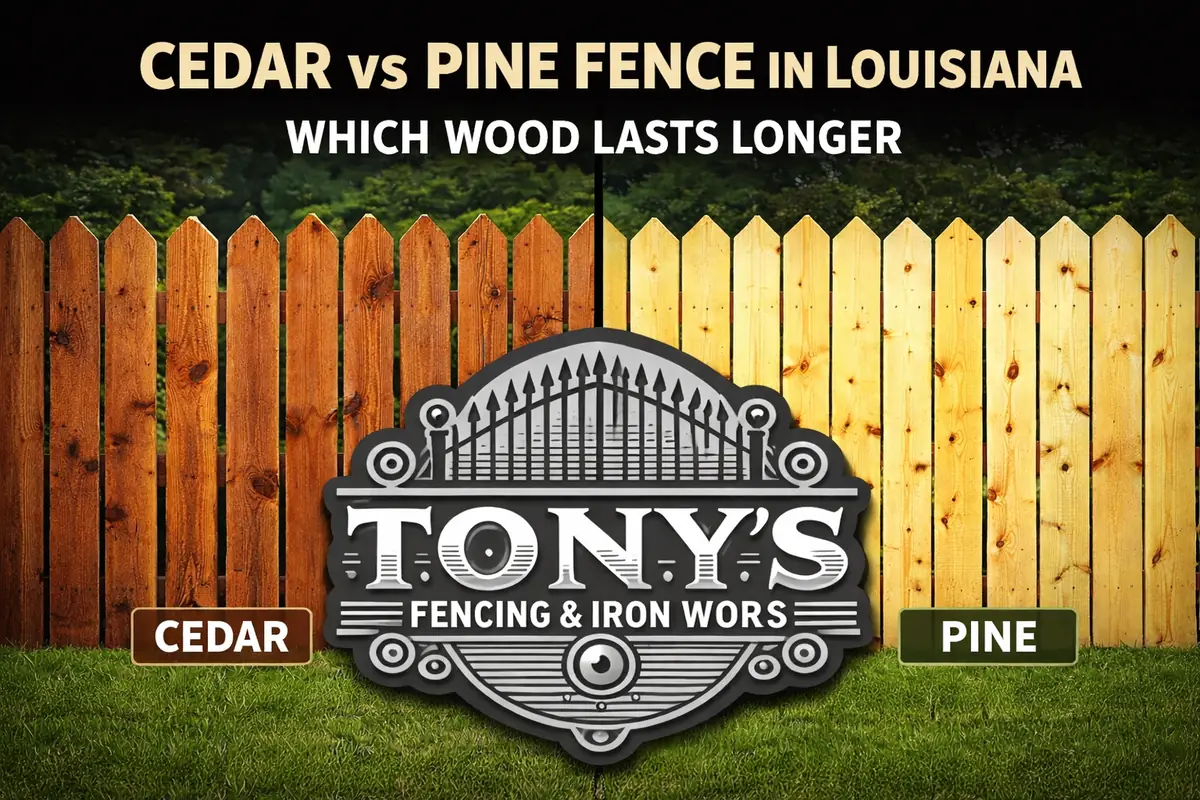
Cedar vs pine fence is one of the most common decisions Louisiana homeowners face when they start getting quotes. Both are real wood fences built on-site. Both look great the day they go up. But they perform differently over a 10- to 15-year window — especially in Southeast Louisiana’s heat, humidity, and heavy rain.
This guide breaks down the real differences so you can make the right call before installation begins.
The Core Difference Between Cedar and Pine
Cedar and pine are both softwoods, but they come from different tree species with different natural properties. Western red cedar contains natural oils that act as a built-in preservative. Those oils repel moisture, discourage insects, and slow the breakdown process that causes rot. Pine does not have those oils. It is a more porous wood that absorbs moisture readily — which is why the industry treats it with pressure-treated chemicals (usually CCA or ACQ) before it gets used for fencing.
In a dry climate, the gap between the two materials narrows considerably. In Louisiana, where summer humidity routinely sits above 85 percent and rain can total 60+ inches a year, that gap widens fast.
How Each Wood Handles Louisiana’s Climate
Heat and UV exposure. Louisiana summers are brutal on wood fencing. Both cedar and pine will check (develop small surface cracks) over time as they cycle through wet and dry seasons. Cedar tends to check less aggressively because its natural oils help it regulate moisture absorption. Pine, once the surface treatment breaks down, checks more readily and can start to split along the grain.
Moisture and rot. Pressure-treated pine is designed to handle ground contact and prolonged moisture exposure. The treatment protects it well in the early years. As the treatment depletes — typically around the 7- to 10-year mark — pine becomes more vulnerable if it has not been resealed. Cedar holds its own longer without intervention because the oils are throughout the wood, not just a surface treatment.
Insects and termites. This one matters in Southeast Louisiana more than almost anywhere in the country. Subterranean termites are extremely active across St. Tammany, Tangipahoa, and Washington parishes. Cedar’s natural oils make it naturally resistant to termites and wood-boring insects. Pressure-treated pine also resists termites — the treatment chemicals are toxic to insects — but that protection depends on the integrity of the treatment layer. A post that has been cut, drilled, or damaged at the surface is an opening.
Ground contact. Fence posts in both cases should be pressure-treated pine regardless of which wood you choose for your pickets and rails. Cedar posts exist but are expensive and harder to source locally. Most professional installations use pressure-treated pine posts with cedar pickets and rails above ground — a hybrid that makes practical and economic sense.
Cedar vs Pine Fence: Lifespan in Louisiana
A properly installed, maintained cedar fence in Southeast Louisiana will typically last 15 to 25 years. A properly installed, maintained pine fence will typically last 10 to 15 years. The gap is real, but both numbers come with a condition: maintenance. A cedar fence that never gets sealed or stained will underperform a pine fence that gets properly maintained on a regular schedule.
The other variable is installation quality. A wood fence built on-site, post by post and board by board, will outlast a pre-assembled panel fence regardless of material. How deep the posts are set, whether the post holes are properly concreted, and how the rails are attached all have a bigger impact on structural longevity than whether you chose cedar or pine. Read more about why pre-made panels fail faster than on-site built fences on the Tony’s blog.
Tony’s Fencing and Iron Works builds all wood fences on-site across the Northshore. See examples in the cedar fence portfolio and on the pine fence service page.
Cedar vs Pine Fence: Cost Differences in Louisiana
Cedar costs more than pine — typically 20 to 40 percent more per linear foot for the fence above ground. The gap comes from material cost at the lumber level. Cedar is not grown or milled as heavily in the South as pine is, so it carries a premium.
For a 150-foot privacy fence, the difference between cedar and pine pickets and rails might run $800 to $1,500 depending on fence height and style. That is real money, but homeowners choosing cedar often recover it in reduced maintenance costs and delayed replacement over a 15-year horizon. For a full breakdown of what fencing costs in Louisiana, see the wood fence cost guide on the Tony’s blog.
If budget is the deciding factor, pressure-treated pine is a solid choice — provided you commit to sealing it on a regular schedule. If you want a fence that performs longer with less intervention, cedar earns its premium.
For guidance on treating and maintaining wood fence materials in humid climates, the Louisiana State University AgCenter is a reliable starting point: lsuagcenter.com
Appearance and Style Considerations
Cedar has a warm reddish-brown tone straight out of the mill. It weathers to a silver-gray if left untreated, which some homeowners find attractive. It takes stain exceptionally well and holds color longer than pine because of the tighter grain structure.
Pine is a lighter, more neutral wood. It stains and paints well but may require more frequent recoating because moisture absorption causes the finish to break down faster. If you want a white-painted privacy fence, pine is typically the more cost-effective substrate — paint covers the material difference, and the lower upfront cost makes sense for a painted finish.
For a natural or stained wood look, cedar gives you a longer window before the finish needs refreshing. See the wood fence finishes guide on the Tony’s blog for help choosing the right stain or sealer.
Which One Should You Choose?
There is no single right answer — but there is usually a better answer for your situation.
Choose cedar if: you want a longer-performing fence with less maintenance intervention, you prefer a natural stained finish, you are building in an area with high termite pressure, or you plan to stay in the home long enough to benefit from the extended lifespan.
Choose pine if: upfront cost is the primary constraint, you plan to paint rather than stain, you are willing to commit to a maintenance schedule, or you need a replacement fence that performs well for the next 10 to 12 years while you decide on long-term landscaping plans.
In either case: use pressure-treated pine posts, build on-site rather than with panels, set posts at the correct depth for your soil type, and seal the fence within 60 to 90 days of installation.
Tony’s Fencing and Iron Works installs both cedar and pine fences across Covington, Mandeville, Hammond, Ponchatoula, Slidell, Madisonville, Franklinton, and surrounding Northshore communities. Call (985) 703-0595 for a free estimate or contact us here.
Frequently Asked Questions: Cedar vs Pine Fence in Louisiana
Does cedar fence really last longer than pine in Louisiana?
Yes — in Louisiana’s climate, cedar typically outlasts pine by 5 to 10 years when both fences receive comparable maintenance. Cedar’s natural oils give it a built-in moisture and insect resistance that pressure-treated pine relies on chemicals to achieve. As those chemicals deplete over time, the performance gap widens.
Is pressure-treated pine fence safe for children and pets?
Modern pressure-treated pine uses ACQ (alkaline copper quaternary) or similar formulations that replaced older arsenic-based treatments. The current treatments are considered safe for residential use around children and pets once the wood has dried after installation. If you have concerns, cedar is a naturally treated alternative with no chemical additives.
Can I use cedar pickets with pine posts?
Yes — this is a common and practical approach. Pressure-treated pine posts handle ground contact and moisture at the base where it matters most. Cedar pickets and rails above ground provide the appearance and longevity benefits of cedar without the cost of cedar posts, which are more expensive and harder to source in Louisiana.
How often does a wood fence need to be sealed in Louisiana?
In Southeast Louisiana’s climate, most wood fences benefit from resealing or restaining every 2 to 3 years. Cedar can stretch to 3 to 4 years between applications because its natural oils slow moisture absorption. Pine typically needs attention on the shorter end of that range, especially if it shows signs of graying or surface checking.