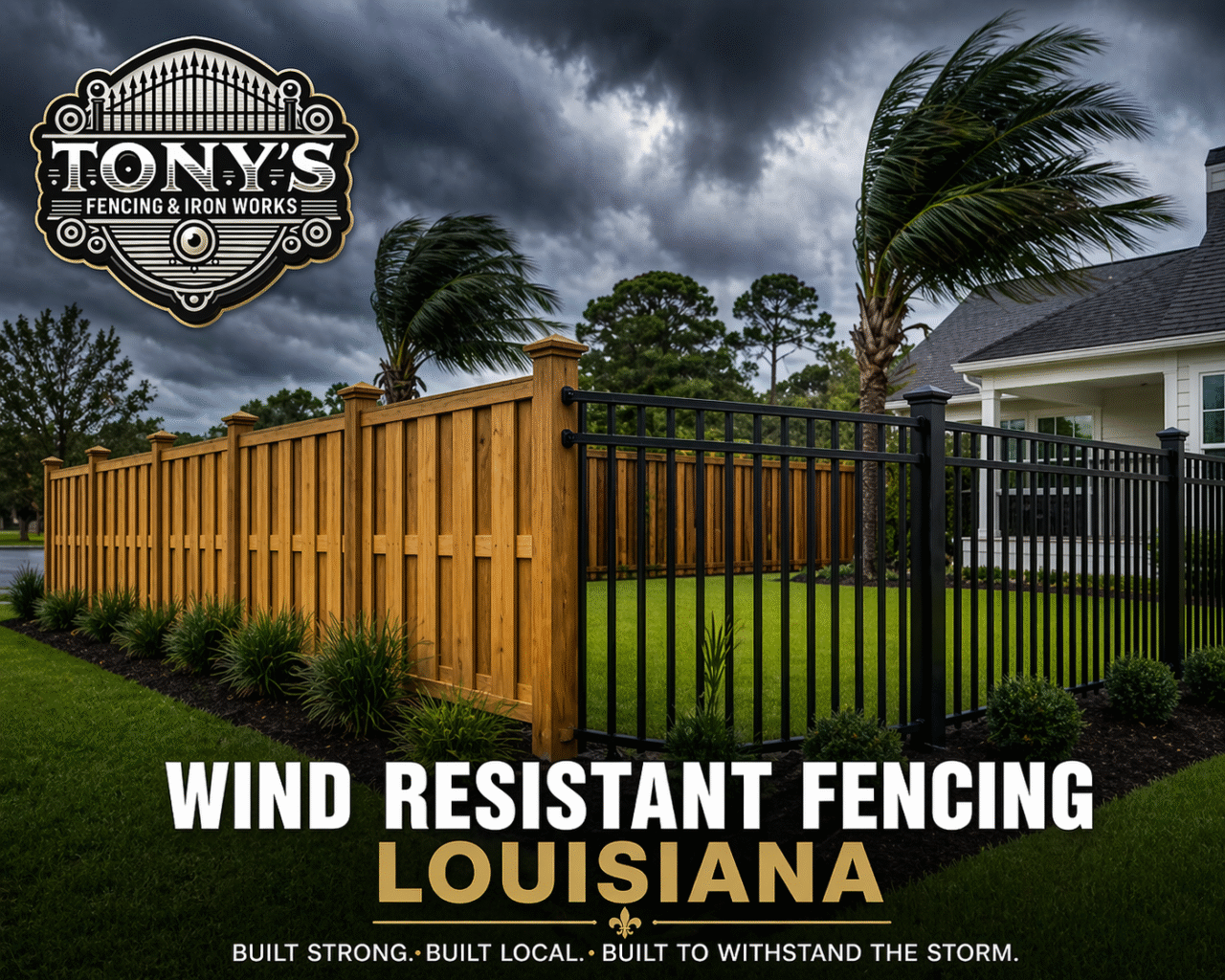
If you live anywhere in Southeast Louisiana — especially in Slidell, Covington, Mandeville, Hammond, or across St. Tammany Parish — you already know how unpredictable storm season can be. That’s why wind resistant fencing Louisiana homeowners rely on isn’t just a luxury upgrade — it’s a necessity.
Between hurricanes, tropical storms, and sudden afternoon wind gusts, fences in our region face constant stress. Many homeowners don’t realize that most fence failures aren’t because of age — they’re because the fence wasn’t built to handle Louisiana’s unique conditions in the first place.
This guide will walk you through exactly how wind affects fences, what designs work best, and how to build or upgrade a fence that actually lasts.
How Wind Actually Damages a Fence (Most People Get This Wrong)
When people think of wind damage, they imagine something knocking a fence over. But in reality, wind works more like pressure than impact.
Here’s what’s really happening:
- Wind pushes against your fence like a wall
- Solid panels trap air and increase pressure
- Wet Louisiana soil loosens post stability
- Repeated gusts weaken joints over time
This creates what contractors call the “sail effect” — where your fence acts like a giant sail catching wind.
The more solid your fence is, the more force it absorbs.
That’s why poorly designed fences often fail during storms, even if they look strong.
Best Wind Resistant Fence Designs for Louisiana Properties
Open-Air Fence Designs: Let the Wind Pass Through
The number one rule of wind-resistant fencing is simple:
👉 The less wind your fence blocks, the longer it lasts.
That’s why open-style fencing is one of the best choices in Louisiana.
Top options include:
- Chain link fencing
- Aluminum fencing
- Ornamental iron fencing
These allow wind to pass through instead of pushing against the structure.
Shadowbox (Board-on-Board) Wood Fencing
If you want privacy and durability, shadowbox fencing is one of the smartest designs available.
Why it works:
- Alternating boards allow airflow
- Reduces pressure from both directions
- Maintains a clean, finished look on both sides
This is one of the most popular styles we install across Slidell and Covington neighborhoods, especially in areas prone to strong crosswinds.
Avoid Fully Solid Panel Fences (Unless Reinforced)
Fully enclosed privacy fences can look great — but they are the most vulnerable to wind damage.
If you choose one, it must be:
- Properly reinforced
- Installed with deeper posts
- Built with stronger materials
Otherwise, it becomes a liability during storm season.
Materials Matter: What Holds Up Best in Louisiana Weather
Cedar vs Pine for Wind Resistance
Material choice plays a huge role in how your fence performs over time.
- Cedar: Naturally resistant to moisture, rot, and warping
- Pine: Pressure-treated but more prone to long-term movement
In Louisiana’s humid climate, cedar tends to hold its shape better — which helps maintain structural integrity during storms.
👉 Learn more here:
https://tonysfencingandiron.com/cedar-vs-pine-fence-louisiana/
Metal Fencing (Aluminum & Iron)
Metal fences are some of the most wind-resistant options available because they combine:
- Open airflow design
- Strong structural framing
- Long lifespan with minimal maintenance
Tony’s Fencing & Iron Works specializes in custom ornamental iron fences and gates, which are ideal for both durability and curb appeal.
The Most Important Factor: Proper Fence Installation
Here’s the truth most homeowners don’t hear:
👉 Even the best fence materials will fail if the installation is weak.
Post Depth & Stability
In Louisiana, fence posts must go deeper than average due to:
- Soft, moisture-rich soil
- Ground shifting after heavy rain
- Flood-prone conditions
A shallow post is one of the biggest reasons fences lean or collapse.
Concrete Reinforcement
High-quality concrete footings help anchor your fence against:
- Wind pressure
- Soil movement
- Long-term wear
This is not an area where cutting corners pays off.
Spacing & Structural Balance
Proper spacing between posts ensures:
- Even distribution of wind force
- Less flexing in panels
- Stronger overall structure
Poor spacing can cause sections to fail like dominoes during storms.
Local Insight: Why Louisiana Fencing Is Different
Fencing in Southeast Louisiana is not the same as fencing in other states.
Here’s why:
- Humidity accelerates wood deterioration
- Storm cycles happen multiple times per year
- Soil conditions vary from clay to sand to saturated ground
- Hurricane-force winds are a real possibility
That’s why hiring a contractor with local experience matters.
Tony’s Fencing & Iron Works has been building fences in this region for over 30 years — meaning every fence is designed specifically for Louisiana conditions.
Signs Your Fence Won’t Survive the Next Storm
Before the next storm hits, check for these warning signs:
- Leaning or shifting posts
- Loose boards or panels
- Rusted or weakened fasteners
- Rot at the base of wood posts
- Sections that move when pushed
If you notice any of these, your fence is already compromised.
How to Upgrade an Existing Fence for Better Wind Resistance
If replacing your fence isn’t an option right now, there are ways to improve its durability:
- Reinforce posts with additional concrete
- Add bracing or support rails
- Replace damaged boards
- Convert to semi-private airflow design
Small upgrades can make a big difference before storm season peaks.
Outbound Link (Authority Boost)
For official hurricane preparedness tips, visit:
https://www.ready.gov/hurricanes
Inbound Link (Internal SEO Boost)
If you’re budgeting for a new fence, check out:
👉 https://tonysfencingandiron.com/how-much-does-a-fence-cost-louisiana/
Conclusion: Build It Right the First Time
Choosing the right wind resistant fencing Louisiana homeowners can depend on isn’t just about appearance — it’s about long-term protection.
A properly designed and installed fence will:
- Last longer
- Require fewer repairs
- Protect your property during storms
If you’re in Slidell, Covington, Mandeville, Hammond, or anywhere in St. Tammany Parish, working with a local expert makes all the difference.
📞 Call Tony’s Fencing & Iron Works at 985-703-0595 for a free quote and expert recommendations tailored to Louisiana conditions.
FAQ Section
What is the most wind resistant fence in Louisiana?
Aluminum, ornamental iron, and shadowbox wood fences are among the most wind-resistant due to airflow and structural strength.
Can a fence survive a hurricane?
Yes, if it’s designed with wind resistance in mind, installed properly, and built using durable materials.
How deep should fence posts be in Louisiana soil?
Typically 2–3 feet deep with concrete reinforcement, depending on soil conditions.
Are privacy fences bad for high wind areas?
They can be if fully solid. Semi-private or reinforced designs perform much better.
How do I protect my fence before a storm?
Inspect for weak points, reinforce posts, and repair any loose or damaged sections.