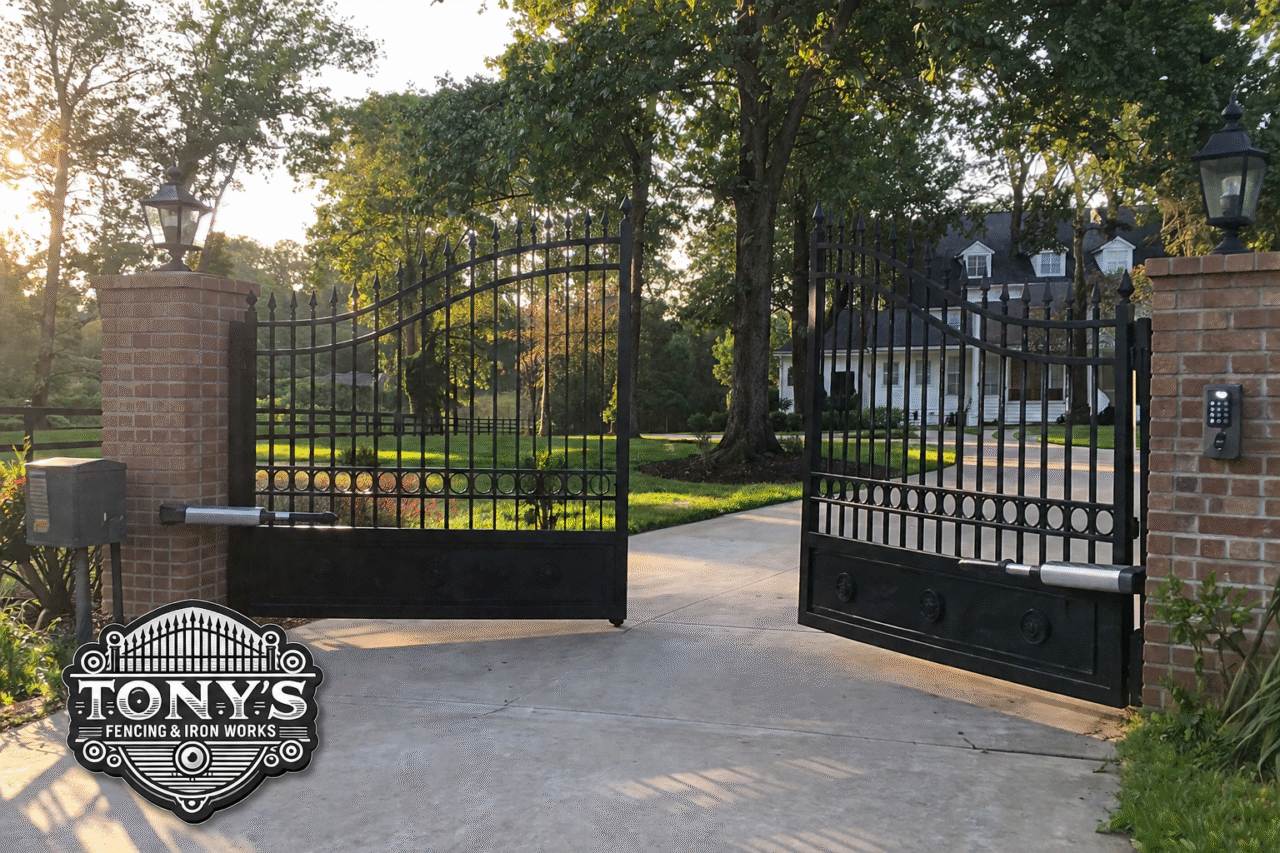
Automatic Driveway Gate Louisiana: What to Know Before You Buy
An automatic driveway gate in Louisiana is one of the best upgrades a homeowner can make — for security, curb appeal, and convenience. But there are real differences between gate types, motor systems, and installation approaches that matter a lot when you live in St. Tammany, Tangipahoa, or Washington Parish.
This guide covers what you need to know before calling a contractor: swing versus slide, ornamental iron versus aluminum, power-outage backup options, what to expect from the installation process, and which questions to ask.
If you want to skip straight to a quote, call Tony’s at (985) 703-0595. Free estimates, every time.
Swing Gate vs. Slide Gate: Which Is Right for Your Driveway?
The first question to answer for your automatic driveway gate in Louisiana is whether your driveway can support a swing gate or needs a slide gate. It comes down to space.
Swing gates open inward or outward on hinges — the same basic principle as a front door. They are the most common choice on residential driveways in Covington, Mandeville, and surrounding Northshore communities. They tend to be less expensive to install, easier to maintain, and easier to customize with ornamental iron designs. The drawback is that they require clear space in the arc of the swing. If your driveway is on a slope, or you park close to the gate, a swing gate may not work.
Slide gates roll horizontally along a track instead of swinging out. They are the better option when space is limited, when the driveway grades sharply near the entrance, or when a wider opening is needed for commercial properties or farm access. The motor system is more complex, the parts have more contact with the ground, and installation costs run higher — but the functionality is hard to beat in the right situation.
Single swing gates work for narrower driveways, typically up to 14 feet. Double swing gates (two panels meeting in the center) handle wider openings and are especially popular for estate-style entries on rural properties in Folsom, Franklinton, and Ponchatoula.
Ornamental Iron vs. Aluminum: Which Material Should You Choose?
Gate material affects cost, maintenance, and how the gate holds up to Louisiana’s climate over time.
Custom ornamental iron is the strongest and most visually striking option. It can be fabricated into virtually any design — flat top, spear top, double arched, scrollwork, monogram panels — and it adds significant curb appeal and property value. The trade-off in Louisiana’s humid climate is that iron requires periodic repainting to prevent rust. Done right and touched up every few years, a quality ornamental iron gate lasts for generations. Tony’s welds every joint and applies a rust-inhibiting primer coat before the final finish so the gate arrives ready to hold up.
Pool aluminum fencing panels are a popular middle ground. Aluminum does not rust, which appeals to homeowners who want lower maintenance, and it is significantly lighter than iron. The aesthetic options are more limited — you are working with pre-fabricated picket styles rather than fully custom fabrication — but for a clean, classic look with minimal upkeep, aluminum gates perform very well.
For most clients looking for a statement entry that holds up on a long rural driveway or an upscale residential lot, custom ornamental iron is the call. For clients who want a no-maintenance option that still looks sharp and meets pool code requirements, aluminum is the smart pick.
How Automatic Gate Openers Work — and What Happens During a Power Outage
The gate itself is only half of an automatic gate system. The opener — the motor, controller, and access hardware — is what makes it automatic.
Most residential automatic gate openers run on 110V or 120V household current, with the motor mounted at the post. The controller manages open/close cycles and connects to your access devices: a remote transmitter, a keypad, a vehicle loop sensor buried in the driveway, or a smartphone app depending on the system.
Power outages are a fact of life on the Northshore, especially during hurricane season. Every automatic gate system Tony’s installs includes a manual release mechanism. In the event of a power loss, you disengage the motor from the gate using a key or lever, which lets you push the gate open or closed by hand. This is standard on all systems and is covered during the post-installation walkthrough.
For homeowners who want to stay automated through outages, battery backup units are available for most gate operator brands. A charged backup battery can cycle the gate open and closed multiple times before it depletes. Solar-powered gate openers are another option for properties where running an electrical line to the gate location is difficult or expensive — they work well in Louisiana given the year-round sun exposure, though they should be paired with a battery to handle cloudy stretches during storm season.
Before hurricane season, Tony recommends confirming your battery backup is charged, testing the manual release so you know how it works under pressure, and securing the gate fully open or fully closed (chained in place) if a major storm is approaching — an unsecured automatic gate can swing wildly in high winds and damage both the gate and the opener arm.
Access Options: Remotes, Keypads, and App Control
How you open and close the gate every day matters as much as the gate itself.
Remote transmitters are the simplest solution — one or two remotes for the vehicles that use the driveway most. They are reliable and require no setup beyond syncing to the controller.
Entry keypads are popular for properties where delivery drivers, family members, or regular visitors need access without a remote. A four-digit code opens the gate from outside. Many systems support multiple codes, which is useful when you want to give contractors temporary access and then delete that code when the job is done.
Vehicle loop sensors are embedded in the driveway surface on the exit side of the gate. When a vehicle drives over the loop, the gate opens automatically from the inside — you never have to use a remote to exit. These are especially popular on properties where residents leave frequently and convenience is a priority.
Intercom systems with camera integration are common on higher-end installations. A visitor presses a call button at the gate, you see and speak with them from your phone or an interior panel, and you can release the gate remotely. This setup provides security without requiring a manned entrance.
Tony’s works with several opener brands and will match the access configuration to how the property actually gets used — not just the cheapest option.
What Does an Automatic Driveway Gate Cost in Louisiana?
Cost varies widely based on gate type, material, width, motor system, and access hardware. That said, here is a realistic range for residential installations on the Northshore:
A single swing gate in powder-coated aluminum with a basic remote-access opener typically starts around $2,500 to $4,000 installed. A custom ornamental iron double swing gate with decorative fabrication and a keypad entry system runs more in the $5,000 to $10,000 range depending on width, design complexity, and how far the electrical run needs to go. Commercial-grade slide gate systems on larger openings are priced from there.
The variables that push cost up most are the electrical run (trenching power from the house to the gate location), concrete work for post foundations, and custom fabrication on the gate itself.
Tony’s provides free estimates on every project. The estimate visit includes measuring the opening, walking the property, discussing access needs, and giving you a written quote with no pressure. Call (985) 703-0595 to schedule.
What to Expect From the Installation Process for Automatic Driveway Gate Louisiana
The timeline for installing an automatic driveway gate in Louisiana depends on fabrication, site conditions, and motor setup — but most residential jobs take one to two days once materials are on hand.
The process starts with setting the posts in concrete and letting them cure — this typically adds a day before the gate can be hung. From there, the gate is installed, the motor and controller are mounted, and the electrical connection is made. The controller is programmed, the auto-reverse safety sensors are adjusted so the gate reverses if it contacts an obstruction, and the access hardware is paired and tested.
Before leaving, Tony walks through the entire system with the homeowner: how to use each access device, how to test the auto-reverse, how to activate the manual release, and how to reach the shop if anything needs adjustment. Every automatic gate installation includes a follow-up check to confirm the controller settings are holding properly — something Tony’s has done on every job for over 30 years.
Do You Need a Permit for an Automatic Driveway Gate in Louisiana?
Permit requirements for an automatic driveway gate in Louisiana vary by parish and municipality. In most unincorporated areas of St. Tammany, Tangipahoa, and Washington Parish, a driveway gate does not require a separate permit unless it is part of a larger fencing project that crosses a permit threshold. Inside city limits — Covington, Mandeville, Hammond, Slidell — the rules differ and it is worth confirming with the local planning or zoning office before starting. For St. Tammany Parish specifically, permit information is available through the St. Tammany Parish Government planning and zoning department.
If your property is in an HOA-governed subdivision, check with your association before finalizing a gate design. Many Northshore HOAs have rules about gate height, color, and style. Tony’s has worked with HOAs throughout the area and is familiar with what typically gets approved — it is worth discussing during the estimate visit to avoid changes after fabrication.
Questions to Ask Before Hiring a Gate Contractor
Before hiring anyone to install an automatic driveway gate in Louisiana, ask the contractor these directly:
Do you fabricate the gate or purchase a pre-made panel? Custom fabrication gives you control over width, design, and finish. Pre-made panels are faster and cheaper but limit what you can do.
Who handles the electrical work? Some gate contractors subcontract the electrical run to a third party, which adds a coordination layer and sometimes a cost gap. Tony’s manages the full installation.
What opener brand do you use, and is it serviceable locally? Parts availability matters. A brand that is not stocked at regional distributors can leave you waiting weeks for a repair.
What does the warranty cover? Know whether the warranty covers the gate structure, the motor, and the controller separately — and for how long.
Do you walk me through the system after installation? Any contractor who installs and leaves without a walkthrough is not one you want adjusting your gate controller.
Tony’s Fencing and Iron Works installs custom automatic driveway gates throughout Louisiana’s Northshore — Covington, Mandeville, Madisonville, Hammond, Ponchatoula, Franklinton, Folsom, Slidell, and surrounding areas. Every gate is built to fit the property, every opener is configured before we leave, and every estimate is free.
Call (985) 703-0595 or fill out our form: https://tonysfencingandiron.com/contact-tonys-fencing-iron/
FAQS
Q: What is the difference between a swing gate and a slide gate? A: A swing gate opens on hinges — inward or outward — and needs clear space in the arc of the swing. A slide gate rolls horizontally along a track and is better for driveways on slopes or tight spaces. Swing gates are more common in residential settings on the Northshore and are generally less expensive to install.
Q: What happens to my automatic gate when the power goes out in Louisiana? A: Every automatic gate Tony’s installs includes a manual release mechanism. During a power outage, you use a key or lever to disengage the motor, then open or close the gate by hand. Battery backup units and solar-powered gate openers are available for homeowners who want automated access through outages during hurricane season.
Q: How long does it take to install an automatic driveway gate? A: Most residential automatic gate installations take one to two days once materials are on hand. Posts are set in concrete first and need time to cure before the gate is hung. From there, the motor, controller, and access hardware are installed, programmed, and tested. Tony’s walks every homeowner through the full system before leaving the job site.
Q: Do I need a permit to install a driveway gate in St. Tammany or Tangipahoa Parish? A: In most unincorporated areas of St. Tammany and Tangipahoa Parish, a driveway gate does not require a separate permit. Inside city limits such as Covington, Mandeville, Hammond, or Slidell, rules vary and it is worth confirming with the local planning office before starting. Tony’s can advise during the free estimate visit based on the property location.